A Choral Method
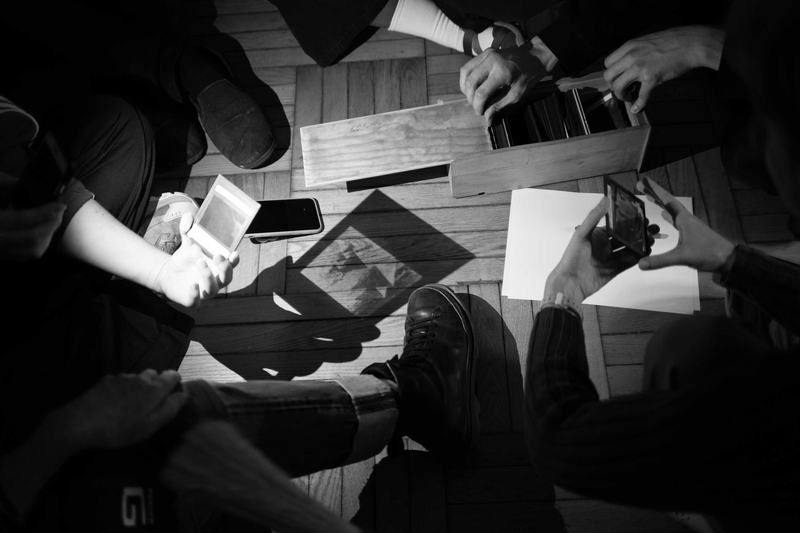
Students working with the archive at LUCA School of Art
Field Studies is a transdisciplinary summer school exploring new approaches to creative practice and collaboration in contemporary art, performance and music. Led by a group of practitioners whose work sits at threshold of different disciplines, the programme forms a polyvocal, multifarous community that creates new work over four days of workshops, studio practice, lectures, eating together, visits and satellite events in the city.
Field Studies: A Choral Method was a transdisciplinary summer school programme exploring the voice, embodiment, and collective work in contemporary art and performance. Led by an international group of artists and practitioners, the programme creates a radically open-minded and dynamic environment for artists to meet and work alongside other creatives, experiment with new ideas, and push the boundaries of their practice.
Field Studies is organised by experimental choral collective Musarc in collaboration with LUCA School of Arts, and in partnership with S.M.A.K. and Kunsthal Ghent. Read more
A Choral Method
Field Studies is organised by experimental choral collective Musarc in collaboration with LUCA School of Arts, Ghent. The programme alternates between open workshops, talks and performances by artists and visiting lecturers, and collective practice in smaller studios where students and tutors work towards the realisation of a project which is presented, or performed on the last day of the programme.
What distinguishes Field Studies is its convivial atmosphere, its radically open pedagogy, and its commitment to doing things with theory. The biographies of the tutors and artists, their respective interests and diverse fields of practice form a starting point. The city, space for shared activities, including eating together, provide infrastructure. The final outcome is unknown at the beginning, and constructed from the individual histories and intentions of students and artists, the ideas and skills they bring, and the material and social interactions that emerge in between.
Field Studies is part of the creative universe and research output of experimental choral ensemble Musarc and its extensive network of artists, composers and singers. Questions around movement, embodiment and technique; the collective voice of the choir and its political and aesthetic dimension; rhythm, repetition and practice; and the idea of knowledge set in motion through performance and a common choreography fundamentally underlie Field Studies as a methodology.
Programme and Application
Field Studies starts on Wednesday 10 September 11am and ends at 3pm on Sunday 14 September 2025. The programme alternates between shared workshops and activities, talks and lectures by the artists, studio practice, visits and satellite events in the city and partnering institutions. A detailed evening programme of public events will be announced early August 2025. Click here to preview the Field Studies 2025 Timetable (general).
Field Studies is open to anyone interested to join. It invites applications from students and practitioners who want to test collaborative and performative processes in relation to a broad range of individual disciplines, from music and composition to fine art and design, architecture, film, poetry, time-based arts as well as curatorial practices and the field of education. To find out more about course fees and how to apply, click here.
Field Studies is organised by Musarc and curated by the ensemble’s creative director Joseph Kohlmaier. Musarc is part of CREATURE, the Centre for Creative Arts, Cultures and Engagement and the School of Art, Architecture and Design, London Metropolitan University. Field Studies 2025 is presented in collaboration with, and generously supported by Luca School of Arts, Ghent.
Venue and Dates
Field Studies 2025: Choir as Method
10–14 September 2025
LUCA School of Arts
Campus Ghent Sint-Lucas
Alexianenplein 1 & 2
9000 Ghent
Belgium
Programme Curators
Partner Organisations
Tutors
Aliaskar Abarkas is an Iranian artist based in London. Informed by alternative and communal art education, their practice fosters dynamic encounters that move from solitary experience toward collective expression. Abarkas often begins with a simple gesture – a sound, a score, a shared activity – which opens up a platform for storytelling through mutual voices, choreographic encounters, and the possibilities held within material processes. Aliaskar is currently a fellow at Sadler’s Wells / Rose Choreographic School (London, 2024–26). He holds a BA in Visual Cultures from the University of Tehran and an MA in the Theory of Contemporary Art and Politics from Goldsmiths, University of London. He was previously a resident at Cubitt Gallery and the Swiss Church (London), and has been an associate artist at Rupert (Lithuania), the Institute of Postnatural Studies (Madrid), Castro (Rome), Open School East, and Syllabus V (UK), among others. His interventions and collaborations have been supported by institutions including the Barbican Centre, ICA Institute of Contemporary Art, The Mosaic Rooms, TACO!, Pushkin House (London), CAPC (Bordeaux), and LOCALES (Rome). Upcoming projects include commissions from Scuola Piccola Zattere (Venice), and the Singapore Art Museum
David Helbich (1973, Berlin) has lived and worked in Brussels, Belgium, since 2002. He studied composition and philosophy in Amsterdam and Freiburg. He works as a sound and performance artist, as a visual and conceptual artist, as well as a conceptual photographer, composer, curator and teacher. He has created experimental works for stage, for print and online media, public space, has worked on artist books, illustrated scores and photo books, as well as live performances and concerts, sound interventions, audio guides and realised work on social media. His trajectory moves between representational and interactive works, closed pieces and open interventions, conceptual gestures and actions. Many of Helbich‘s works and performances thematise concrete physical and social experiences, repositioning the audience as active and extending the space of performance. A recurring technique in this context is ‘self-performance’, whereby the audience takes on the roles of both performer and addressee. In addition to numerous lectures, workshops and performances, Helbich’s work has been exhibited and presented internationally, including at the Queens Museum (NYC), D Museum (Daelim Museum, Seoul), Kanal – Centre Pompidou (Brussels), Martin-Gropius-Bau (Berlin), Palais de Tokyo (Paris), Oude Kerk (Amsterdam), Philharmonie Luxembourg, UnionDocs (New York) and Café OTO (London). He has been commissioned by festivals such as Rainy Days in Philharmonie Luxembourg, Still Walking in Birmingham, Festival van Vlaanderen in Kortrijk, SPOR in Aarhus, Skanu Meg Festival in Riga, Borealis and Lydgalleriet in Bergen, Kunstenfestivaldesarts in Brussels, and Ultima in Oslo. Helbich’s curatorial and editorial projects include the online platform 1000 Scores – Pieces for Here, Now & Later which he founded in 2020 with Helgard Haug and Cornelius Puschke.
Volkmar Klien (*1971, Hollabrunn, A) spent his childhood in Vienna engulfed in the city’s rich musical life with all its glorious traditions and engrained rituals. Working from this background Volkmar Klien today strives to extend traditional practices of composing, producing and listening far beyond established settings of concert music. He works in various areas of the audible and occasionally inaudible arts navigating the manifold links between different modes of human perception, spheres of presentation and the roles these play in the communal generation of meaning. His works have been widely recognized, exhibited, performed and presented. He has received commissions from institutions truly varied in nature. For the Volksoper Wien (Vienna, A) he composed music to a full evening ballet, the Curtis R. Priem Experimental Media and Performing Arts Center (EMPAC) (Troy, USA) invited him to produce multi-channel electronic sound works, and for Transitio_MX (Mexico City, MX) he produced a mixed media installation acoustically surveying landscapes. In his installation Aural Codes he turned the radio sphere over London into his exhibition space inviting residents to tune in and also interact. Throughout his career he has collaborated with his choreographer brother Michael on numerous performative projects exploring relationships between sound, bodily movement and human communication. Works stemming from this ongoing collaboration have been produced and presented at the ZKM Karlsruhe, Ballet Frankfurt, the Hayward Gallery London, and - most recently - by the Martha Graham Company in co-operation with the New Museum (NY). Volkmar Klien’s work has been awarded numerous prizes and awards, amongst these are the Media Arts Prize of the City of Vienna, State Scholarships for Composition of the Republic of Austria, an Honorary Mention at Ars Electronica, the Max Brand Prize for Electronic Music, the Scholarship of the Vienna Symphonic Orchestra, the Alban Berg Stipendium and the Gustav Mahler Prize for Composition. In his artistic work Volkmar Klien can draw on experience gained in academic research. Having received a PhD in electroacoustic composition from the City University London he has held research positions at the Royal College of Arts in London, the Austrian Research Institute for Artificial Intelligence (OFAI) and the University for Music and Performing Arts Vienna. He is a professor for composition at the Anton Bruckner University (Linz, Austria).
Klara Kofen is an artist, dramaturg, writer, and researcher whose work is concerned with histories – speculative, counterfactual, real and imagined – and the ways technological interfaces shape our relationship to time and affect. As the artistic director of Waste Paper Opera since 2015, she creates sound-based multimedia performances that challenge traditional boundaries between live art, music, and technology. The collective defines opera as a form of multimodal performance spanning light, sound, speech, voice, gesture, film, sensing and sculpture – combining objects, space, and infrastructure. She also performs with Phorne, a band with Cameron Graham exploring sensory percussion, voice, and technologically mediated environments. Her research is rooted in a background in early modern history, particularly the history of science, the French Revolution, legal and metabolic histories, and the historiography of rupture. She has written and presented on subjects including trade secrets and artificial intelligence, the origins of meteorology, mystical sects in the seventeenth century, baroque gesture, scientific diagrams, and models of common ownership in performance. Her practice weaves historical inquiry with motion capture, speech, film, installation, and digital media, often working across synchronous and asynchronous timeframes. Recent works include fake & extinct (Centrale Fies, 2025), which stages dialogues between stones and legal philosophers to explore non-synchronous sovereignty and water infrastructures; Admiror, or Revolutionary Sentiments (Guggenheim Museum, NYC, 2024), a collaboration with Bahar Noorizadeh on the sentimental logic of capitalism; and Dead Cat Bounce (2024 UK tour), an oratorio about finance and catastrophe created with Gary Zhexi Zhang. In opera, Kofen collaborates as a dramaturg and writer with ensembles including Ensemble Molière and Opera Settecento. Her writing has appeared in Catastrophe Time! (MIT Press/Strange Attractor, 2023) and through Onomatopee. She is currently a creative fellow at the Institute of Advanced Studies at UCL London, and was previously a fellow on the Guildhall School of Music & Drama’s Opera Making course. She studied history at the University of Glasgow and the University of Oxford. Klara was born into a Greek/Polish family and grew up in a commune in Düsseldorf. She works at the Bookartbookshop in London and occasionally investigates international trade shows.
Loré Lixenberg is a singer and maker. Her own work extends into coding, sound art, radiophonic work, film, and direction – shaped by the needs of the idea. After training as a mezzo-soprano, Lixenberg went on to apply operatic voice to physical theatre with Théâtre de Complicité and the revolutionary, controversial comedy club KUUUB ZARATHUSTRA. She has since performed in opera houses, music festivals, galleries, and public spaces internationally, performing works by composers and artists such as Frédéric Acquaviva, Georges Aperghis, Dai Fujikura, Bernard Heidsieck, Isidore Isou, Janice Kerbel, Bruce McLean, ORLAN, Karlheinz Stockhausen, David Toop, Mark-Anthony Turnage, and Trevor Wishart, often in collaboration with the artsits and premiering countless new works written for her voice. Lixenberg studied composition with John Woolrich, Andy Vores, and Robert Saxton, and took masterclasses with Peter Maxwell Davies. She later trained as a singer with Jessica Cash, Andrew Powell, Paul Hamburger, Martin Isepp, and Galina Vishnevskaya. Her background in composition informs her wide-ranging vocal practice and her own works, which draw on extended vocal technique, operatic structure, and participatory digital forms. She has collaborated with leading ensembles – including Klangforum Wien, Ensemble Intercontemporain, BCMG, Ensemble Recherche, and Cikada – performing music by György Ligeti, Harrison Birtwistle, Salvatore Sciarrino, Earle Brown, Jennifer Walshe, Pauline Oliveros, Conlon Nancarrow, Helmut Oehring, and Kevin Volans. She has performed at festivals such as Donaueschingen, Darmstadt, Witten, Wien Modern, and Ultima, and her repertoire ranges from experimental opera to politically charged performance art. She is possibly the only mezzo-soprano to have sung Luciano Berio’s music with Bronski Beat and Radiohead. Her own operatic and performative projects explore the intersection of voice, politics, economy, and technology. These include PRET A CHANTER (a live fashion-opera), THE SINGTERVIEWS (a series of sung interviews), SINGLR (a real-time operatic dating app), VOXXCOIN (a blockchain-based opera exploring fiscal exchange), and LETHE (a film opera on death rituals). Her piece theVoicePartyOperaBotFarm[myMuseIsMyFury] won the Phonurgia Nova international sound art prize in 2021. In 2017, she founded THE VOICE PARTY, a hybrid artwork that functions as both political party and opera. She stood as a candidate in the UK general elections of 2019 and 2024, turning electoral participation into a durational performance. As a director, she has staged works by Mauricio Kagel, Nam June Paik, Trevor Wishart, Niels Rønsholdt, and Salvatore Sciarrino, in venues including Den Frie (Copenhagen), The Sage Gateshead, SPOR Festival, and the Danish Royal Opera. Her productions often combine direction with performance, design, and film, such as THE FOOL (a mockumentary opera rehearsal) and An Evening with Pierrot Lunaire. In 2023 she directed and performed Sir Peter Maxwell Davies’s Miss Donnithorne’s Maggot with Neue Oper Fribourg. Lixenberg co-directed the Berlin-based art space La Plaque Tournante with Frédéric Acquaviva – a hub for historic and contemporary avant-garde sound, text, and performance – awarded the Berlin Senate Prize for Best Project Space in 2017. Her discography includes NANCARROWKARAOKE (a multitracked vocal transcription of Conlon Nancarrow’s player piano rolls, De Player, 2020), The Afternoon of a Phone (£@B), and the first complete CD recording of John Cage’s Songbooks (Sub Rosa), with Greg Rose and Rob Worby. Her artist book Memory Maps and her recent radio works for Kunstradio (Austria) and Deutschlandfunk Kultur (Germany) continue her practice across media. Lixenberg completed her PhD at the University of York in 2024. In 2026, she will premiere new works by Jennifer Walshe and Philip Venables at the Cartier Foundation in Paris and Musica Strasbourg, and appear at Wigmore Hall in concert with her duo Akkordeon Baroque.
Carolyn Roy has been a member of Musarc since 2023, participating as a vocal performer and writer in most of their projects since joining. She lives with unilateral hearing loss, which, as well as prompting explorations of mis-spoken words, (bad) singing and soundings, has produced a particular sensitivity to resonance – specifically the way that our bodies are touched and moved by sound and the more subtle resonance generated by bodies in shared space. Carolyn is a London-based, freelance dancer and writer with a PhD in dance, who works in the independent dance sector. As a practitioner channelling the somatic processes and understanding we use as dancers through other art forms, her body of presented/published work includes poetic and critical texts, sound narratives, film and photographic projects as well as live performances and political actions. In recent years her practice has focused on examining philosophical concepts through the materiality of bodies. Performance and text projects (2018–2022) explored what it is to be with others in this world, what it is to be-with as dancers, the politics (and pleasure) of dancing, with reference to Jean-Luc Nancy’s Être Singulier Pluriel. She is currently working in collaboration with dance-maker Amy Voris using scores derived from Experiential Anatomy as a way of encountering propositions made by Anne Dufourmantelle in Puissance de la douceur. Carolyn has performed in work by Gaby Agis, Marina Collard, Keira Greene, Derek Jarman, Graeme Miller, Florence Peake, Pacitti Company, Tino Sehgal, and Margarita Zaffrilla Olayo. She has been a visiting lecturer at the Architectural Association, Bartlett School of Architecture, East London University, Cambridge University, Lincoln University and teaches regularly at Trinity Laban, LCDS and Independent Dance, as well as leading workshops for non-dancers in community and healthcare settings. Carolyn is an activist member of artist-led collective, Chisenhale Dance Space.
Michael Schmid (www.breathcore.org) is a flutist and experimental musician, known for his work with the Belgian Ictus Ensemble and collaborations with Europe’s leading new music groups. His practice spans sound installations, concrete poetry, and composition. Since 2015, he has developed BREATHCORE, a project exploring breath in artistic, social, and political contexts, which has toured worldwide. He is the (co)founder of The Breathing Saloon together with choreographer Pieter Ampe, a platform dedicated to breath-focused practices. The duo is currently researching breath for their upcoming production ARIA, set to premiere in 2026. Schmid’s work has been showcased at prestigious festivals and venues, including Kunstenfestival des Arts, Kaaitheater, and BEAF. He has collaborated with renowned artists such as Anne Teresa De Keersmaeker, Boris Charmatz, Manon de Boer, Georges Aperghis and Simon Steen-Andersen. His installations and performances, including The Pitch and Breathcore – Riviera Blues, reflect his innovative approach to breathing as a musical instrument. He has released recordings with labels like KAIROS and WERGO and appeared on international radio and television.
Keynote Speakers
Imogen Stidworthy’s sculptural installations and films are shaped by different forms of voicing, through sound, body, and spatial and temporal relationships. She spends time and stages situations with people whose language is shaped by powerful experiences, neurological conditions, such as aphasia, or cultural practices, such as shamanism. Her work grapples with the impossibility of glimpsing language from the outside; ‘What happens to sense-making in encounters with unfamiliar or unrecognisable forms of voicing? What different forms of communication emerge in spaces between languages? In recent years I’ve been engaging with these questions through the lens of autism, and non-verbal being.’ She completed her PhD ‘Voicing on the Borders of Language’ at Lund University (SE) in September 2020. In 2018 she was awarded the Special Prize for the inaugural David and Annely Juda Award and has won and been shortlisted for many awards and prizes.
Born in Taipei in 1971, Lin Chiwei is a transdisciplinary artist who received academic training in French literature, cultural anthropology and media art. Since the early 1990s, Lin has been involved in the Taiwanese counter-cultural scene. He was a founding member of noise band Z.S.L.O. and responsible for the programming of various alternative art festivals. At the same time, Lin explored the realms of religious music and art, notably temple sculpture and Taoist rituals, through intense research and field studies. These experiences, combined with his practice in noise performance and electronic music composition, developed into critical positions toward contemporary art practices. Since 2004, Lin has worked on the Tape Music and IDCM (Interhuman Dynamic Coordinated Models) series of works – synchronous protocols which allow individual autonomy in the forming of collective intelligence that leads to complex sound works. In his 2012 book Beyond Sound Art – The Avant Garde, Sound Machine and the Modernity of Hearing, Lin denies the term ‘Sound Art,’ and provides a holistic view blurring the boundary between human culture and technology. Lin’s art works were shown in various biennales and museums including Tate Modern, Pompidou Center, PSA Shanghai along with other non-art sites including local community projects, private residences, public schools, factories, churches, temples, bars and live venues in different countries around the world. Lin Chiwei lives and works in Shanghai, Taipei, and Paris.
Cameron Dodds is an artist, researcher, and lecturer whose work moves between composition, theory-fiction, ritual practice, and technology. His current project, the Haunted Network Research Initiative (HNRI), is a speculative archive reconstructing the work of the ‘disappeared’ composer Cameron Dodds. Drawing on cybernetic strega-hacking, weirding as process, and magic as method, HNRI explores unstable zones between scholarship and invention. Alongside this, Cameron runs Creativity Analysis, a post-qualitative framework that integrates philosophy and psychoanalysis to support resilience in creative practice. He regularly lectures on composition, creativity, and wellbeing at the University of West London, and has presented his research at institutions including the Jung Club (London), KASK (Ghent), and ZHdK (Zurich). He holds a PhD in Composition from the Guildhall School of Music and Drama, and his monograph Magic as Method: Praxis, Meaning, and the Re-enchantment of Process will be published by Intellect Press in 2027. Cameron is also working on his debut novel, a maximalist exploration of English village greens, urination magic, mathematics, aliens, folk traditions, hauntings, internet speeds, and neuromancy.
Participants
Emilie Amrein (they/them) is a scholar, artist, educator, and activist whose professional activities resist and unsettle the boundaries of academic disciplines. They locate their work in community practice, drawing on the revolutionary wisdom of abolitionist, anti-colonial, and anti-capitalist organizers and freedom dreamers from the Majority World. Widely regarded as one of the most progressive thinkers in the arts and social justice in the United States, Amrein’s professional life traverses a number of disciplines, epistemologies, and fields. They position themself in the confluence and trans spaces of arts education, community arts, community development, activism, and public practice in the arts. Amrein’s professional work has taken them to diverse settings, spanning professional arts ensembles, and engagement with incarcerated folx, refugees and asylum-seekers, LGBTQ+ communities, and justice-deprived locations. They have given numerous talks for national and international audiences and creative workshops with community groups. Their co-authored book, Empowering Song, is considered a ground-breaking pedagogical and epistemological frame. Amrein currently serves as Executive Director of UTSA Arts, Associate Dean for community engagement, and professor of community arts leadership, education, and practice at the University of Texas at San Antonio.
Lucinda Bell (they/them) is a composer and musician based in London and Oxford. Birds are a focus of their work which aims to gain appreciation of bird behaviour through their own perspectives and cognitive processes by mixing sound aspects of composition with other media types, most often poetry and photography. Combined with minimalistic tendencies and their experience of synaesthesia, used to create timbral, textural and harmonic frameworks, in their work birds can be understood authentically and with clarity. lucindabellcomposer.squarespace.com
Charo Calvo is a Spanish electroacoustic composer, sound designer and teacher, living in Belgium. After having performed as a dancer with the influential Belgian dance company Ultima Vez, she started her studies on Electroacoustic Composition in 1992. Her work as composer is being developed through different media, widely diffused on international venues and festivals, dance performances, theatre, film and radio. Her work has received important international awards. She is a lecturer at ARTS2 and KASK and Conservatorium Ghent.
soundcloud.com/user-562545561
Emma Clark is a performance maker working primarily within the London-based artist duo emma + pj, a collaborative studio practice spanning performance, installation, multimedia, and co-creation. The collaboration explores humanity in extreme landscapes, creating cinematic, otherworldly environments that invite us to reimagine our place in the world. Her work has been presented across the UK at venues including the Barbican Centre, Summerhall, New Diorama, and The Yard. She was a Barbican Open Lab resident artist and has published performance texts with Bloombury UK/Methuen Drama. She recently made her Royal Court Theatre directing debut on Joel Tan’s Scenes from a Repatriation. www.emmaandpj.com
Andy Cowton ‘I’ve been working as a composer and sound designer for many years. My main field of work has been writing for contemporary dance, cinema and tv documentary and fiction. I originally trained in dance and theatre at Dartington College of Arts. These studies were rooted in improvisation and collaboration, with a strong leaning towards site specific work: “technique” as such seemed a secondary consideration or rather something that was discovered and maybe self defined. It’s with this methodology in mind that I approached music composition. I was initially turned on to music/sound composition after attending a series of classes in electro acoustic music composition at Morely College London with composers Barry Anderson and Philip Waxman. I also joined agit-prop industrial noise group Test Dept with whom I toured and performed for 2 years. Over the years my work has led to long standing relationships with filmmakers , dancers and artists all of which invite new beginnings and new ways of working together. As a member of Musarc, I’m delighted to be able to extend these ideas and practices with other artists, singers and performers.’ www.andycowtonmusic.com
Leopold Frey is a filmmaker, storyteller and researcher with an academic background in theatre, cultural studies, modern philosophy and cinema directing. He is currently pursuing a PhD in audiovisual art and ethical AI at LUCA and KU Leuven, where he is researching interactions and states of mind in human and nonhuman agents, while exploring a poetics of transformation for expanded cinema at the intersection of intuition as method, artistic collaboration, and creative media practices.
Rani Geroult is a vocalist and educator whose work bridges performance, pedagogy, and research. Rooted in vocal jazz, her practice has grown into an experimental and participatory approach that invites collective creation through voice and listening. She has explored drama in education in China and music education in France, deepening her focus on children’s voices, the native tongue, and the role of sound in shaping identity. Central to her research is the metaphor of the house with a hidden ground, a space where memory, imagination, and inner voices find resonance.
Jawid Ghani ‘I was born in 1989 in Balkh, in the north of Afghanistan. In 2010 I left for India to study where I was introduced to ghazal music and learned to play the harmonium, which I accompany with singing. In 2016 I came to France to study for an MA in International Trade, and since 2019 I have been working at ASLC, a linguistic and cultural association in Paris. Persian culture in all its forms has always been central to me. In my work I share Persian poetry and Afghan music in Europe, and strive to preserve Afghan musical heritage by every possible means. My repertoire includes Persian ghazals, Afghan folk songs, and more contemporary works by popular Afghan singers such as Ahmad Zahir, while also drawing inspiration from Indian music. In recent years I have also composed original pieces blending Afghan traditions with French poetry (Ronsard, Éluard, Louise Labé, Baudelaire, Verlaine). With fellow musicians I perform regularly in France, in museums, theatres, universities, migrant centres, and embassies (Tadjikistan et Afghanistan). We also participate in local cultural events and, more recently, had the opportunity to share Afghan music with a wider audience on French television in Culture Box.’
Lucy Gunning’s practice involves installation and live events that juxtapose diverse material and spatial elements, engaged with the entanglement of a given site/context. Often working with moving image, sculptural or found objects, architectural intervention. There is an ongoing interest in performativity, temporality, space, matter and the intangible. Informed by literature, feminism, queer theory, and esoteric practice. She is represented by Matt’s Gallery, London, and teaches at Chelsea College of Arts.
Francesca Hawker (born 1992, UK) lives in Brussels and is a Research Assistant at LUCA Ghent, where she is exploring embarrassment in performance art. She often works collaboratively within the ‘slapstick of ordinary relation’, defined by Lauren Berlant as a way of ‘trying to stay in the same enough conversation in order to build something together that neither of us could build by ourselves.’ francescahawker.net
Lize Maekelberg ‘I create objects and textiles that picture my dreams, allowing my imagination run free on how I would love the world to look. Clinging on to feelings of nostalgia, happiness, loneliness, optimism, and uncertainty, I’m currently working on an ever-growing installation series of beach towels. I took an optimistic approach to my own doubtful artistic and personal quest after graduating from art school. Why do I make this (art)work? What drives me? How do I feel when I create this work? In search of playfulness, collectivity, fun, pleasure, beauty, festivity, freedom, and a place to land, I wash, card, spin, and dye wool for a farm just outside of Ghent. The work serves as an invitation for a collective, peaceful moment of relaxation. In my practice, I perpetually balance between what is beautiful and kitsch, between the heritage of domestic textiles and my own, queer, playful little life. I swing between performing caring rituals and a reckless painterly etiquette, pingponging between my imagination and encounters with the real world. By turning away from the horrors of today and reflecting on them, I aim to create playful, colorful, and intimate work. The long process of washing, carding, dying, and spinning the wool, beginning from a raw material, is a time-consuming, all-consuming waltz of care. When working with wool, I always imagine the sheep as close friends of mine. I make something out of their beloved winter coat. In the beginning of 2023, I started a long-lasting residency with Manoeuvre, a Ghent-based co-creation collective. Working with people of different atmospheres, we cook, sing, knit, crochet, felt, and weave to make art that intertwines craft and daily life. It is a joy to work, cry, laugh, and dance collectively, together, horizontally.’
Carol Mancke is an artist and architect who, after many years practicing and teaching architecture, broadened into individual and collaborative art practices. Carol brings time, objects, images, movement, humor, hospitality and conversation into play to prompt alternative ways of participating in everyday life. Her artwork has featured in shows in Britain, Australia, the US and Japan, and her PhD research (‘Thinking in Public: The Affordance of Hopeless Spaces’, RCA 2021) explored collaborative thinking as a public artistic practice that might build agency in the public sphere. In 2018 Carol founded machinaloci space, a place for playful research into alternative ways of being, thinking, and doing together which she ran in Berkeley California until 2022. She will launch machinaloci space London in December 2025. She has been singing with Musarc since 2022 and helping with the administration of the choir since 2024.
Paul Martin Art School: Painting, Reliefs, Sculpture, Environment & Performances with fellow students including electronic tape. Sculpture: Tape Pieces (with fan) Film: River Film, Mist on Mountains etc. Competitions: Botanic Gardens Station, Glasgow; Bellevor Tor, Dartmoor; River Crossings, London. Book: Spirals through Eye. Exhibition: Along the Roman Wall – LYC Museum, Banks (photographs). Sound: Crossness Pumping Station. Field Studies 2012 and following with Davide Tidoni, Aki Onda and Akio Suzuki, Joseph Kohlmaier and others. Musarc Choir since 2013. Unbuilt roads.
Amélie Mourgue d’Algue’s practice focuses on artistic mediation and collaborative art, with a keen interest in the experience of linguistic plurality. In 2021, she co-founded the artistic research group Bureau des Heures Invisibles (bhi), located in Aubervilliers, Greater Paris. She is the initiator of Ensemble Plurilingue, produced by the bhi, that has brought together professional and semi-professional artists, actors, singers and musicians living in and investing the soundscape of Aubervilliers and Greater Paris for collective and participatory compositions since 2022.
Loïs Pluymers is an artist and saxophone player working at the intersection of sound, movement, and materiality. Her artistic practice moves between the individual and the collective, between the visual and the musical, between fixed form and improvisation. Central to this is a desire to blur the boundaries between disciplines: to understand music as movement, image as sound. Her practice is grounded in listening: not just to sound, but to what materials, environments and objects have to say. I search for moments where different systems – musical, physical, social – overlap, break open or rub against each other, where patterns unravel. In search for the tension between the mechanical and the personal, the coded and the chaotic, the structured and the improvised.
loispluymers.cargo.site
Júlia Rúbies Subirós (she/they) is a graduate of P.A.R.T.S. She has worked with choreographers including Alix Eynaudi, Georgia Vardarou, and Mette Ingvartsen, touring across Europe as a performer. She has been involved in collective research through Cascades, which she initiated in Barcelona, and in Brussels through her participation in MOTA000 and as co-initiator of Accompany Class. She has been entering a new phase in her work, where the voice becomes central to her choreographic practice, unfolding as both subject and medium in the creation of her upcoming piece She Spells Sea Shells on the Shea Sore. jurusu.cargo.site
Shamica Ruddock is a London-based artist-composer thinking through film, live improvisation, recorded musics, collaborative research and glass. Research interests encompass vernacularity, (techno)creolisation, transferral and legibility. Shamica is inspired by detours and tangents, mishaps and accidental arrivals. www.shamicaruddock.com
Listening, sounding, performing, choreographing & facilitating, Tanya Soubry (she/they) works with the body, voice, place and matter, tending to the choreographic, the sonic and the ecological. Rooted in decoloniality, political ecology and environmental justice, Tanya researches, imagines and creates with, following tensions, curiosities, desires and care, so as to process the past and present and create possibilities, through sensuousness, humour, collaboration, collectivity and solidarity. As a choreographer and artist, Tanya has created, performed and toured work in Europe, Canada and Hong Kong, from stage performances, to immersive and participatory projects, to gallery installations, and now site-sensitive land-based work. www.taniasoubry.com
Aga Ujma is a singer, composer, and multi-instrumentalist from Poland. She grew up around folk music from the mountain village where her mother is from. At the age of eight, she signed herself up for music school to study classical piano and music theory. Later, she studied Renaissance and Baroque music analysis while also being fascinated with punk and noise. In her twenties, she became obsessed with gamelan and moved to Java to study traditional music and singing at the Indonesian Institute of Arts. There, she joined an experimental music collective, touring extensively across the Indonesian archipelago. She now learns the harp, lives between London and Poland, and has recently toured the world with Black Country, New Road; Hinako Omori; and Crack Cloud. She performed the theme song for Resident Evil: Village and plays with various music projects, including folk collective Broadside Hacks.
‘I am jorre vandenbussche (b. 1975, Bruges, Belgium). I graduated in 1997 as Master in Drama from the Conservatory of Antwerp. I have worked as an actor, theatre maker and writer with companies large and small in Flanders and the Netherlands. In 2015 I co-founded theatre company MAELSTROM. I have been searching for my own voice for as long as I can remember, and that quest is still going on, both in my work as an actor and as a teacher.’